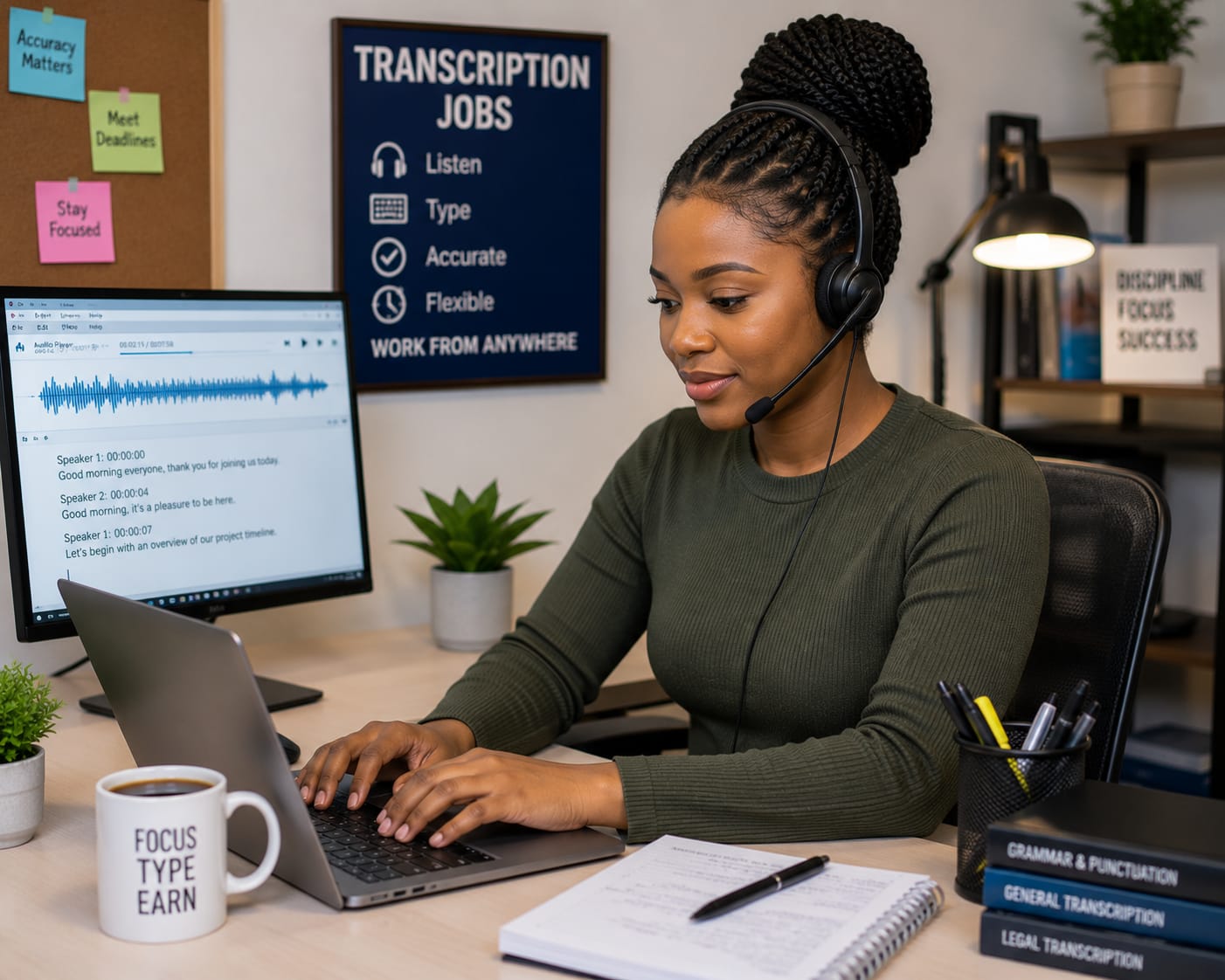
Transcription Jobs From Home in South Africa
Transcription is one of the most accessible remote jobs for South Africans. You convert audio or video recordings into written text — and you can do it all from home. The work is flexible, requires no formal degree, and pays in US dollars if you work with international platforms.
With reliable equipment and good English skills, you can earn between $4 and $25 per hour depending on the platform and your experience level. This guide covers everything you need to know — from essential equipment, free training options, and the best platforms hiring South Africans right now, to a step-by-step guide on getting your first transcription job.
What the Job Involves – Transcription Duties
Transcriptionists listen to audio or video recordings and type out exactly what is said. The work can range from short voice notes to hour-long interviews, meetings, or court proceedings.
Key duties include:
Listening to audio clips and transcribing them accurately
Following specific formatting and punctuation guidelines
Flagging unclear audio, background noise, or cut-off speech
Adding timestamps or speaker labels where required
Proofreading transcripts for accuracy and grammar
Delivering completed work on time
Types of transcription:
General transcription: Podcasts, interviews, business meetings, YouTube videos
Legal transcription: Court proceedings, depositions, legal dictation
Medical transcription: Doctors' notes, patient records, medical reports
Verbatim transcription: Capturing every word, including filler words, pauses, and repetitions
AI training transcription: Short clips to improve voice AI platforms
Salary Guide – Transcription Jobs (2026)
Pay rates vary by platform, experience, and type of work. International platforms pay in US dollars — a major advantage for South Africans.
Entry-level (no experience):
$4 – $7 per hour (approximately R72 – R126 per hour)
Experienced transcriptionists (Upwork):
$4 – $25 per hour
AI training transcription:
$12.50 per hour (10–20 hours per week)
Legal / Medical transcription (specialised):
$10 – $25+ per hour, depending on experience
Local SA rates (JOBVINE):
~R30 per hour for beginners
Note: Rates are in US dollars for international platforms. With the current exchange rate, earnings can be significantly higher than local minimum wage jobs. Specialising in legal or medical transcription increases your earning potential.
What You Need to Start
Technical Equipment
Laptop or desktop computer with reliable performance
High-quality headphones to catch every word clearly
Stable internet connection (fibre or LTE recommended)
Quiet workspace — background noise affects accuracy
Smartphone (for some AI recording platforms)
Skills You Need
Excellent written English skills, including punctuation and sentence structure
Good listening skills and attention to detail
Typing speed of 40+ words per minute (faster is better)
Ability to follow structured guidelines consistently
Self-discipline to work independently with minimal supervision
Documents You Need (for platforms)
✅ Updated CV
✅ Certified copy of ID
✅ Proof of address (sometimes required)
✅ PayPal, Payoneer, or Wise account for international payments
✅ South African bank account for local payments
Essential Training and Resources
You do not need a degree to start transcribing, but training improves your accuracy and confidence.
Free resources:
Practice transcribing YouTube videos or podcasts for free
Read style guides on grammar and punctuation
Learn about verbatim vs clean verbatim transcription
Online courses (paid, optional):
CPD-certified Transcription courses are available from R180+
These courses cover listening techniques, grammar, formatting, and where to find work
Book recommendation:
"Working From Home as a Transcriptionist in South Africa" by Gaynor Paynter — a practical guide written by a South African transcriptionist, covering load-shedding, client management, and local business setup
Formal qualifications (for language professionals):
NWU offers a BA in Language and Literary Studies with Language Practice modules in translation, interpreting, and subtitling
This is ideal if you want a professional career in language services
Platforms Hiring South African Transcriptionists
1. Rev
One of the largest transcription platforms globally.
Pay: Varies by project
Pros: Flexible hours, work from home, international clients
Cons: Some reviewers mention audio quality issues and strict grading
How to apply: Visit Rev.com and complete their transcription test
2. Upwork
Freelance marketplace where you set your own rates.
Pay: $4 – $25 per hour (set your own rate)
Pros: Build long-term client relationships, choose your projects
Cons: Requires building a profile and getting reviews
How to apply: Create a profile, list your skills, start bidding on transcription jobs
3. Welo Data (Welocalize)
AI training data project — perfect for short-term work.
Pay: $12.50 per hour
Commitment: 10–20 hours per week for up to 6 weeks
Duties: Listen to 5-second audio clips and transcribe them, flag background noise
How to apply: Apply through Bayt.com or Welocalize careers
4. Luel AI
Earn money recording and transcribing in South African languages.
Pay: $7.50 – $12+ per hour
Languages: isiZulu, isiXhosa, Afrikaans
Tasks: Voice recording, audio transcription, language checking
How to apply: Download the app, create a profile, start recording
5. Local Platforms (JOBVINE, Freelance SA)
South African-specific freelance platforms.
Pay: ~R30 per hour for beginners
Languages: English, Sesotho, Setswana, isiZulu, Afrikaans
How to apply: Create a profile on JOBVINE or local freelance sites
How to Apply for Transcription Jobs – Step by Step
Step 1: Choose Your Platform
Decide which platform suits your skill level and experience. If you are a beginner, start with Rev or Luel AI. If you have experience, create a profile on Upwork.
Step 2: Prepare Your Equipment
Ensure you have a working computer, reliable internet, and noise-cancelling headphones. South African load-shedding is a challenge — consider investing in backup power.
Step 3: Practise Your Typing Speed
Test your typing speed using free online tools. Aim for at least 40 words per minute. Faster typing means higher earnings.
Step 4: Create Your Profile
For Rev: Sign up and complete the transcription test. If you pass, you can start working immediately.
For Upwork: Create a profile, list your skills, and add a professional photo. Highlight your experience and language skills.
For Luel AI: Download the app, enter your email, select your home language, and start recording.
Step 5: Submit Your Application
Follow the platform's specific application process. Most international platforms require a test or sample to assess your skills.
Step 6: Start Small and Build Your Reputation
Start with shorter, easier tasks. Build positive reviews. As your reputation grows, you can increase your rates and take on specialised work (medical, legal, or AI training).
Step 7: Manage Your Business
Set up PayPal, Payoneer, or Wise for international payments
Keep records of your income — SARS requires you to declare it
Consider registering as a provisional taxpayer if your income exceeds the threshold
Invest in professional development — specialise in medical or legal transcription for higher rates
Tips for Succeeding as a Transcriptionist
Invest in good headphones — Poor audio quality is the biggest challenge in transcription
Learn to follow style guides — Each client or platform has specific formatting rules
Manage load-shedding — Have a backup power plan
Specialise in legal or medical transcription — These fields pay significantly more
Join online communities — Facebook groups and forums offer support and advice
Be patient — Building a reputation takes time, but consistent work leads to higher rates
Update your skills — The transcription industry is evolving, with AI tools becoming more common
Common Mistakes to Avoid
❌ Not having reliable equipment — Poor audio quality leads to mistakes and negative reviews
❌ No backup power — Load-shedding will disrupt your work
❌ Applying to platforms without checking requirements — Some platforms require a test or sample
❌ Underpricing your services — You can charge higher rates as you gain experience
❌ Only applying to one platform — Diversify your income sources
❌ Not creating a professional profile — A good profile attracts better clients
Transcription Scam Warning – Protect Yourself
Red flags:
🚩 Someone asks for money to help you get transcription work — legitimate platforms are FREE
🚩 The "platform" asks for your banking password — never share this
🚩 They promise guaranteed income with no effort
🚩 They claim you need to pay for "exclusive access" to jobs
Protect yourself:
Only apply through verified platforms (Rev, Upwork, Welocalize)
Never pay for a job application
Check reviews of the platform before applying
FAQ: Transcription Jobs in South Africa
Q: Can I start transcription with no experience in South Africa?
A: Yes. Platforms like Rev and Luel AI accept beginners. You may need to pass a short test to get started.
Q: How much can I earn as a transcriptionist in South Africa?
A: Entry-level: $4 – $7 per hour. Experienced: $10 – $25 per hour. AI training transcription: $12.50 per hour.
Q: Do I need a degree to do transcription?
A: No. You need good English skills and attention to detail. Formal training or certification helps but is not required.
Q: What equipment do I need?
A: A computer, good headphones, and a stable internet connection. Consider backup power for load-shedding.
Q: Can I work part-time as a transcriptionist?
A: Yes. Most transcription work is flexible. Many platforms allow you to choose your hours.
Q: What is AI training transcription?
A: You listen to short audio clips and transcribe them to improve voice AI platforms. Welo Data and Luel AI offer this type of work.
Q: How do I get paid for transcription work?
A: International platforms pay via PayPal, Payoneer, or Wise. Local platforms pay into South African bank accounts.
Q: What South African languages are in demand?
A: isiZulu, isiXhosa, and Afrikaans are in demand for AI training and local transcription.
Conclusion
Transcription jobs offer a flexible, accessible way to earn money from home. You do not need a degree — just good English, attention to detail, and reliable equipment. International platforms pay in US dollars, making this a lucrative option for South Africans.
Start by practising your typing speed, investing in good headphones, and applying to platforms like Rev, Upwork, or Welo Data. Specialise in legal or medical transcription for higher rates.
👉 Browse more remote jobs on JoblySA – find transcription and work-from-home opportunities
👉 Join our WhatsApp group – get daily job alerts and remote work tips